Wall insulation can make a noticeable difference to how warm and comfortable a home feels. If your property loses heat quickly, feels cold even when the heating is on, or has a poor EPC rating, the walls may be one of the first areas worth checking.
Two of the most common terms you may come across are cavity wall insulation and solid wall insulation. They sound similar, but they are designed for different types of homes.
The main difference is simple: cavity wall insulation is for walls with a gap between two layers, while solid wall insulation is for walls without a cavity.
This guide explains how they differ, how to tell which type of wall your home may have, and what to think about before insulating.
Why Wall Insulation Matters
In an uninsulated home, a large amount of heat can escape through the walls. Energy Saving Trust says around a third of heat lost in an uninsulated home escapes through the walls, so improving wall insulation can help reduce heat loss, make rooms feel warmer and support lower heating demand.
For many homeowners, wall insulation is also relevant because it can affect the property’s Energy Performance Certificate, or EPC. A home that holds heat better may be easier to heat and may perform better in an energy assessment, although the exact EPC impact depends on the whole property.
Across older housing stock, especially in areas with Victorian terraces, stone cottages, post-war semis and mixed-age properties, wall construction can vary a lot. That is why it is important to identify the wall type before choosing an insulation option.
What Is Cavity Wall Insulation?
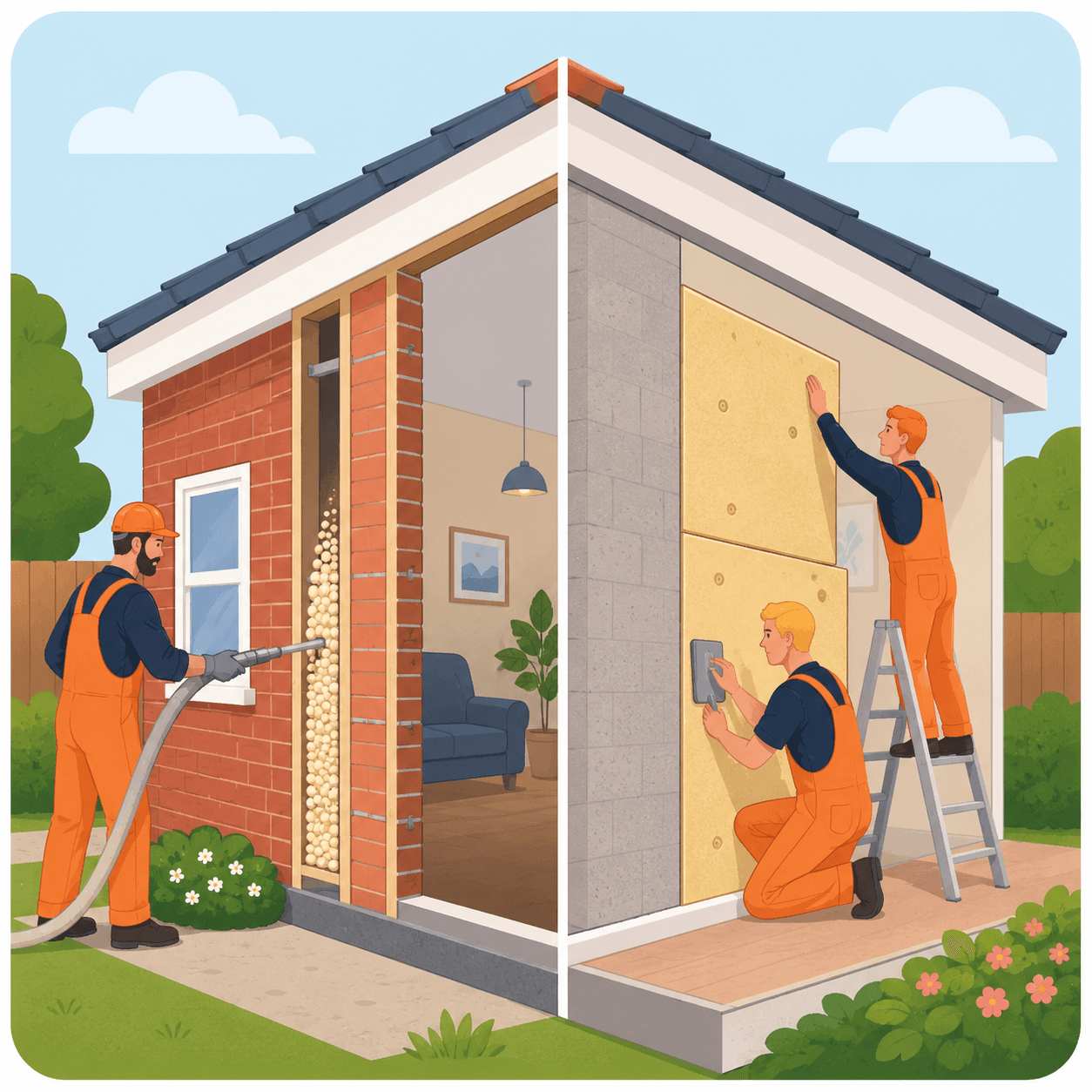
Cavity wall insulation is used in homes that have cavity walls. A cavity wall is made of two layers, usually an inner wall and an outer wall, with a gap between them.
This gap is called the cavity. If it is suitable and unfilled, insulation can usually be injected into the gap from the outside of the property.
Cavity wall insulation is designed to reduce heat loss through the wall by filling that empty space with insulating material. Common materials can include mineral wool, beads or foam products, depending on the property and installer.
In general, cavity wall insulation is often less disruptive than solid wall insulation because the work is usually carried out from outside. Small holes are drilled into the external wall, insulation is injected, and the holes are then made good.
What Is Solid Wall Insulation?
Solid wall insulation is used in homes that have solid walls. Solid walls do not have a cavity, so they cannot be filled in the same way as cavity walls.
Energy Saving Trust explains that homes built before the 1920s are more likely to have solid walls, and because there is no gap, solid walls need to be insulated either from the inside or the outside.
There are two main types of solid wall insulation:
Internal wall insulation, where insulation is fitted to the inside face of external walls
External wall insulation, where insulation is fitted to the outside of the property and finished with render, cladding or another protective finish
Solid wall insulation can be very effective, but it is usually more involved than cavity wall insulation. It may affect room sizes, external appearance, fixtures, fittings, ventilation and sometimes planning requirements.
How to Tell Which Type of Wall You Have
You may be able to get an initial idea by looking at the age and brick pattern of your home, but a proper assessment is still the safest route.
Property Age
As a general guide:
Homes built before the 1920s are more likely to have solid walls
Homes built after the 1920s are more likely to have cavity walls
Homes built from the 1990s onwards are more likely to already have some wall insulation
Energy Saving Trust gives the 1920s as a useful guide for identifying whether a home is more likely to have solid or cavity walls.
Brick Pattern
Brick pattern can also give clues:
If the bricks are laid mostly lengthways, the home may have cavity walls
If you can see a mix of long and short brick ends, the home may have solid walls
This is only a guide. Rendered walls, stone walls, extensions and previous alterations can make it harder to tell.
Wall Thickness
Wall thickness may also help. A solid brick wall may be narrower than a cavity wall, although this depends on the property and construction type.
Professional Survey
The most reliable way to confirm the wall type is through a survey. An installer or assessor can check the wall construction, cavity condition, exposure, damp risk, ventilation and whether insulation is suitable.
This matters because the wrong insulation, or insulation installed in the wrong conditions, can cause problems.
When Cavity Wall Insulation May Be Suitable
Cavity wall insulation may be suitable if:
Your home has cavity walls
The cavity is not already filled
The walls are in good condition
There are no significant damp issues
The property is not overly exposed to wind-driven rain
The cavity is wide enough and clear enough
The external walls can be accessed safely
For suitable homes, cavity wall insulation can be a practical and relatively low-disruption upgrade.
However, it is not right for every cavity wall. If the cavity is narrow, blocked with rubble, affected by damp or exposed to severe weather, insulation may need careful assessment or may not be recommended.
When Solid Wall Insulation May Be Suitable
Solid wall insulation may be suitable if:
Your home has solid external walls
The walls are structurally sound
Any damp or moisture issues have been addressed
Internal or external installation is practical
Ventilation can be managed properly
The finish is suitable for the property
Any planning or conservation requirements are considered
Solid wall insulation is often more common in older homes, including Victorian terraces, early 20th-century houses, cottages and some stone-built properties.
Because solid wall insulation changes how a wall handles heat and moisture, it needs to be designed carefully. Historic England advises careful consideration before insulating walls in historic buildings, particularly where traditional construction, moisture movement and ventilation are involved.
Internal vs External Solid Wall Insulation
If your home has solid walls, there are usually two main options: internal or external insulation.
Internal Wall Insulation
Internal wall insulation is fitted to the inside of external walls. This can be useful where you want to preserve the outside appearance of the property or where external insulation is not practical.
Possible benefits include:
- External appearance is usually unchanged
- It can be installed room by room
- It may be suitable where planning restrictions apply
- It can improve comfort in rooms with cold external walls
Things to consider:
- It reduces room size slightly
- Skirting boards, sockets and radiators may need moving
- Redecoration will usually be needed
- Disruption inside the home can be significant
- Moisture and ventilation need careful management
External Wall Insulation
External wall insulation is fitted to the outside of the property and finished with render, cladding or another suitable protective finish.
Possible benefits include:
- It does not reduce internal room size
- It can improve the outside appearance of some homes
- It wraps the building in a continuous insulation layer
- It may reduce cold spots more effectively
- Less disruption inside the home compared with internal work
Things to consider:
- It changes the external appearance
- It may need planning permission in some situations
- It can affect gutters, window sills, pipes and external fittings
- Scaffolding is often required
- It can be more complex on terraced or detailed properties
The right option depends on the property, budget, appearance, access, planning rules and how the home is used.
Which Is More Disruptive?
Cavity wall insulation is usually less disruptive because most of the work is carried out from outside and can often be completed relatively quickly.
Solid wall insulation is usually more disruptive. Internal insulation affects rooms directly and may require furniture moving, plastering, decorating and changes to fittings. External insulation may require scaffolding and changes to external details such as pipes, gutters and sills.
This does not mean solid wall insulation is a bad option. It simply means it needs more planning.
Which Costs More?
Solid wall insulation usually costs more than cavity wall insulation because the work is more involved and uses more materials.
Energy Saving Trust lists typical cavity wall insulation costs in Great Britain at around £2,700, though the final cost depends on property size and other factors.
Solid wall insulation is usually a larger project because insulation has to be fitted to the inner or outer face of the wall rather than injected into a cavity. Costs vary significantly depending on whether the insulation is internal or external, the size of the property, access, finish and the condition of the walls.
Some households may be eligible for funding or support through energy efficiency schemes, depending on property type, EPC rating, household circumstances and current scheme rules.
Which Saves More Energy?
Both types of insulation can reduce heat loss, but the impact depends on the starting point.
Cavity wall insulation can make a big difference if the cavity is currently empty and the property is suitable.
Solid wall insulation can also make a significant difference because solid walls can lose a lot of heat. Energy Saving Trust says solid wall insulation can help cut heating costs and make a home more comfortable.
However, it is not helpful to compare the two as if every home can choose between them. In most cases, your wall type determines the option. A cavity wall needs cavity wall insulation. A solid wall needs internal or external solid wall insulation.
The better question is: what wall type does my home have, and what is the most suitable way to insulate it safely?
What About Damp and Ventilation?
Damp and ventilation are important with any insulation work.
Before insulating walls, it is sensible to check for:
- Penetrating damp
- Rising damp
- Condensation
- Poor ventilation
- Blocked gutters or downpipes
- Cracked render or pointing
- Damaged brickwork
- Leaking roofs or sills
Insulation can improve comfort, but it should not be used to hide existing building problems. If moisture issues are already present, they should be investigated first.
This is especially important in older solid-walled properties, where walls may be designed to manage moisture differently from modern cavity walls. Traditional buildings may need breathable materials and careful ventilation design.
Can Wall Insulation Improve Your EPC Rating?
Wall insulation can help improve an EPC rating, but the exact impact depends on your home.
An EPC looks at the property as a whole, including walls, roof, floor, heating, hot water, windows and lighting. If walls are a major source of heat loss, insulating them may improve the rating and reduce estimated energy use.
However, insulation is only one part of the picture. A home may also benefit from loft insulation, heating controls, boiler upgrades, solar panels, draught-proofing or window improvements.
A good starting point is to check your current EPC and look at the recommended improvements for your specific property.
Questions to Ask Before Installing Wall Insulation
Before going ahead, it is worth asking:
- Do I have cavity walls or solid walls?
- Is the wall suitable for insulation?
- Are there any damp or ventilation issues?
- What insulation method is being recommended and why?
- Will the work affect the appearance of my home?
- Will I need planning permission?
- How disruptive will the installation be?
- What guarantees or warranties apply?
- Is the installer qualified and accredited?
- Will the work affect my EPC rating?
- Is funding available?
- What aftercare is included?
Clear answers can help you make a more confident decision.
Which Type of Wall Insulation Is Right for Your Home?
The right type of wall insulation depends on the structure of your home.
If your property has suitable unfilled cavity walls, cavity wall insulation may be the right option. It is usually simpler, less disruptive and more affordable than solid wall insulation.
If your property has solid walls, cavity wall insulation is not possible. In that case, internal or external solid wall insulation may be considered, depending on the property and your priorities.
For many homes, wall insulation works best as part of a wider plan. Loft insulation, heating controls, boiler efficiency, ventilation and draught-proofing all affect how comfortable and efficient a home feels.
Final Thoughts
Cavity wall insulation and solid wall insulation both aim to reduce heat loss through external walls, but they are designed for different types of properties.
Cavity wall insulation fills the gap between two wall layers. It is often suitable for homes built after the 1920s, provided the cavity is clear, dry and appropriate for insulation.
Solid wall insulation is used where there is no cavity. It can be fitted internally or externally and is often relevant for older homes built before the 1920s.
The most important step is identifying your wall type and checking whether insulation is suitable. A proper assessment can help avoid problems and make sure the recommended upgrade is right for the property.
At Warmr, we help homeowners understand practical energy-efficient home upgrades, including cavity wall insulation, solid wall insulation and wider improvements that can make homes warmer and easier to heat. The best advice starts with the building itself, not a one-size-fits-all recommendation.