Air source heat pumps are becoming a more common option for homeowners looking at efficient, low-carbon heating. But for many people, they still feel a bit unfamiliar.
Most of us understand the basic idea of a boiler: it burns fuel, heats water and sends that water around radiators. A heat pump works differently. Instead of burning gas or oil to create heat, it uses electricity to move heat from outside air into your home.
That might sound surprising, especially in winter. But even cold air contains heat energy. An air source heat pump captures that heat, raises it to a useful temperature, and uses it to warm your home and hot water.
This guide explains how air source heat pumps work in simple terms, what parts are involved, and what homeowners should think about before choosing one.
What Is an Air Source Heat Pump?
An air source heat pump is a heating system that takes heat from the outside air and uses it to heat your home.
For most UK homes, the common type is an air-to-water heat pump. This means it transfers heat into water, which then circulates around your central heating system.
An air source heat pump can usually provide:
- Space heating through radiators
- Space heating through underfloor heating
- Hot water through a hot water cylinder
- Lower-carbon heating compared with fossil fuel systems
- Efficient heating when the system is properly designed
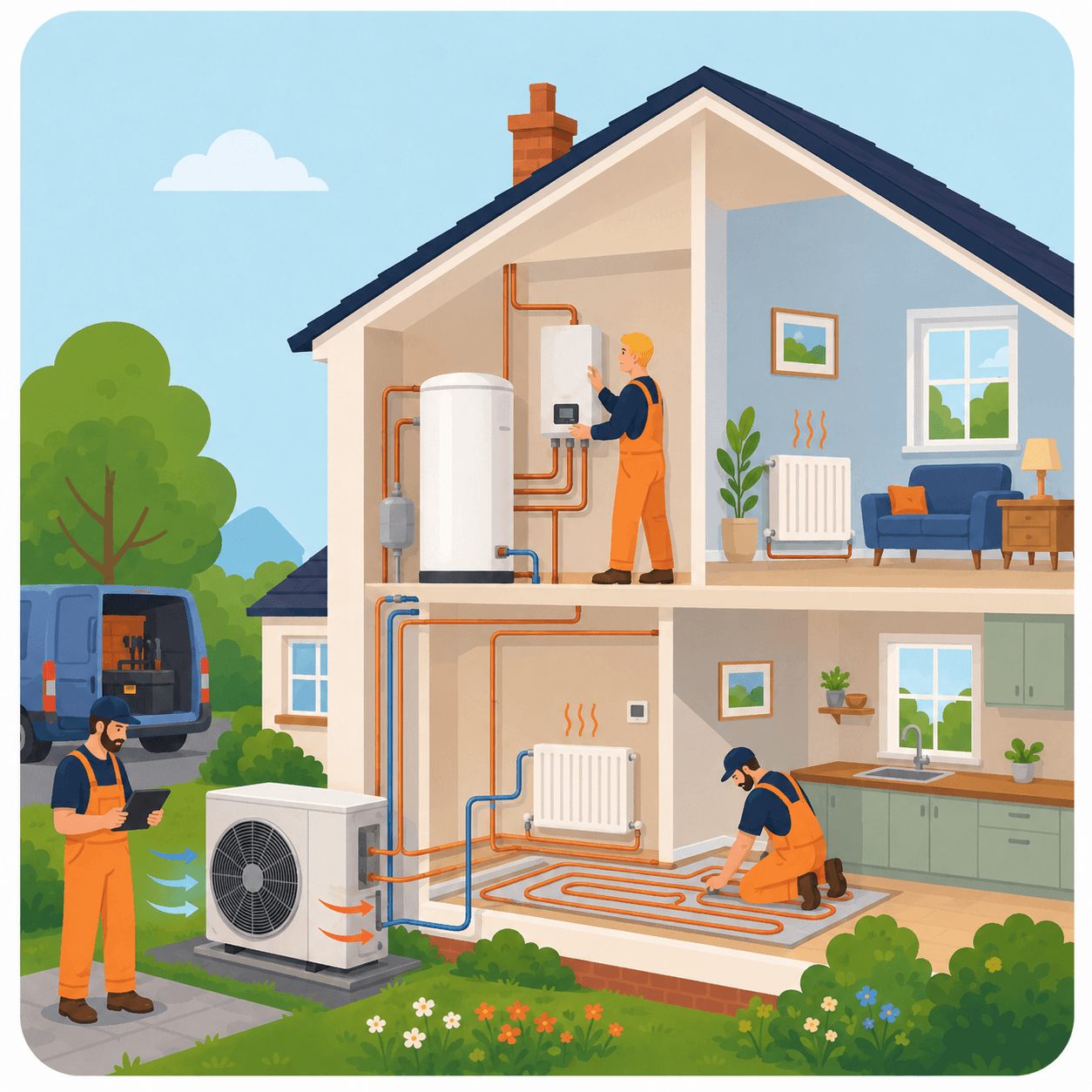
The outdoor unit is usually installed outside the property, often near an external wall, in a garden, at the side of the house or in another suitable outdoor location.
How Does an Air Source Heat Pump Work?
The easiest way to think about a heat pump is that it works a bit like a fridge, but in reverse.
A fridge takes heat from inside the fridge and releases it into the room. A heat pump takes heat from outside air and moves it into your home.
The process has a few main stages:
- The outdoor unit draws in air
- Heat from the air is absorbed by a refrigerant
- The refrigerant is compressed to increase its temperature
- That heat is transferred into the home’s heating system
- Warm water is sent to radiators, underfloor heating or a hot water cylinder
The important point is that the heat pump is moving heat, not creating it by burning fuel. This is why heat pumps can be very efficient when installed and used correctly.
Can a Heat Pump Really Work When It Is Cold Outside?
Yes. Air source heat pumps can still work in cold weather because there is still heat energy in the air, even when it feels cold.
The heat pump does need to work harder when the outdoor temperature drops, but modern systems are designed to operate in typical UK winter conditions.
This is one of the reasons correct design is so important. A heat pump should be sized and installed based on the home’s heat loss, insulation, radiator capacity and hot water needs. If the system is too small, poorly designed or fitted in a home that loses heat quickly, it may struggle to perform well.
What Are the Main Parts of an Air Source Heat Pump System?
An air source heat pump system is made up of several key parts.
Outdoor Unit
The outdoor unit is the part most people recognise. It usually looks like a large box with a fan. It draws in outside air and extracts heat from it.
The unit needs enough space around it for airflow. It should not be boxed in, blocked by plants or placed somewhere where air cannot move freely.
Refrigerant Circuit
Inside the system is a refrigerant, which is a special fluid that absorbs and transfers heat. The refrigerant changes temperature and pressure as it moves through the system, helping carry heat from the outdoor air into the home.
Compressor
The compressor raises the pressure and temperature of the refrigerant. This is a key part of how the heat pump increases the temperature enough to heat water for the home.
Heat Exchanger
The heat exchanger transfers heat from the refrigerant into the water that circulates through the central heating system.
Hot Water Cylinder
Most air-to-water heat pumps use a hot water cylinder to store hot water for taps, baths and showers. This is different from many combi boiler systems, which heat hot water on demand.
If your home currently has a combi boiler and no cylinder, space for a hot water cylinder will need to be considered.
Controls
Heat pump controls manage when and how the system heats the home. These may include thermostats, programmers, smart controls, weather compensation and hot water settings.
Good controls help the system run steadily and efficiently.
How Does a Heat Pump Heat Radiators?
In an air-to-water system, the heat pump warms water and sends it around the central heating system.
This water flows through radiators or underfloor heating, releasing heat into each room.
However, heat pumps often work at lower flow temperatures than traditional gas boilers. This means the water going to the radiators may not be as hot as it would be with a boiler.
Because of this, the system may need:
- Correctly sized radiators
- Larger radiators in some rooms
- Double-panel or higher-output radiators
- Underfloor heating where suitable
- Good heating controls
- Proper system balancing
- Good insulation to reduce heat demand
A heat pump can work with radiators, but the radiators need to be able to deliver enough heat at the lower water temperature.
Why Do Heat Pumps Run Differently from Boilers?
A boiler often heats water to a higher temperature and may turn on and off in shorter bursts.
A heat pump usually works best when it runs more steadily at lower temperatures. Instead of quickly blasting heat into the home, it gently maintains a comfortable temperature over a longer period.
This can feel different at first.
With a heat pump:
- Radiators may feel warm rather than very hot
- The system may run for longer periods
- Temperature changes may be more gradual
- The home should be kept at a steadier temperature
- Controls may be set differently from a boiler system
This does not mean the system is not working. It simply means it is designed to heat in a different way.
Do Air Source Heat Pumps Provide Hot Water?
Yes, most air-to-water heat pump systems can provide hot water as well as space heating.
Instead of heating hot water instantly like a combi boiler, a heat pump usually heats water stored in a cylinder. The cylinder stores hot water ready for use.
This means the size of the cylinder matters. It needs to be suitable for the household’s hot water demand.
A home with one bathroom and two occupants may need a different setup from a larger property with several bathrooms and a busy household.
The installer should assess:
- Number of bathrooms
- Shower and bath use
- Household size
- Available cylinder space
- Existing plumbing
- Hot water usage patterns
- Cylinder insulation and performance
A well-sized cylinder helps the system provide enough hot water without unnecessary energy use.
Why Insulation Matters with Heat Pumps
Air source heat pumps work best in homes that can hold onto heat.
If a property loses heat quickly through the roof, walls, floors, windows or draughts, any heating system has to work harder. This is especially important for heat pumps because they are designed to provide steady, efficient heat rather than very high-temperature bursts.
Before installing a heat pump, it is worth checking:
- Loft insulation
- Wall insulation
- Floor insulation
- Window condition
- Door draughts
- Loft hatch insulation
- Pipe insulation
- Ventilation and damp issues
A heat pump can work in older homes, but the building needs to be assessed carefully. In many cases, insulation improvements can make the system more effective and comfortable.
Does a Heat Pump Need Bigger Radiators?
Sometimes, but not always.
Because heat pumps usually run at lower flow temperatures than boilers, some existing radiators may not give out enough heat. In those cases, larger or higher-output radiators may be recommended.
However, not every radiator automatically needs replacing. Some homes already have radiators that are large enough, especially if insulation has been improved or the radiators were generously sized in the first place.
A proper room-by-room heat loss calculation should identify:
- How much heat each room needs
- Whether existing radiators are suitable
- Which radiators may need upgrading
- Whether underfloor heating would help
- Whether pipework changes are needed
- What flow temperature the system can run at
This is why heat pump design should not be based on guesswork.
What Is a Heat Loss Calculation?
A heat loss calculation estimates how much heat each room loses in cold weather.
It looks at factors such as:
- Room size
- Ceiling height
- Wall type
- Roof insulation
- Floor type
- Window size and glazing
- External walls
- Draughts
- Ventilation
- Desired room temperature
- Property age and construction
This calculation helps determine what size heat pump is needed and whether the radiators or underfloor heating can provide enough warmth.
A good heat pump installation should be designed around the home’s actual heat demand.
Where Does the Outdoor Unit Go?
The outdoor unit needs to be placed somewhere with good airflow and safe access.
Common locations include:
- Side of the house
- Rear garden
- Patio area
- External wall area
- Ground-mounted position
- Suitable flat roof or platform in some cases
The location should consider:
- Airflow around the unit
- Distance from neighbours
- Noise levels
- Access for maintenance
- Pipe routes into the property
- Visual appearance
- Drainage
- Manufacturer clearances
- Avoiding leaves, debris and obstructions
The unit should not be hidden in a tight cupboard or boxed into a restricted space. It needs air to work properly.
Are Air Source Heat Pumps Noisy?
Air source heat pumps do make some noise because the outdoor unit has a fan and compressor.
However, modern units are designed to be relatively quiet. The exact noise level depends on the model, how hard it is working, where it is positioned and the surrounding environment.
Good placement matters. An installer should consider nearby windows, neighbouring properties, walls, fences and reflective surfaces.
The outdoor unit should be positioned so it works efficiently without causing unnecessary disturbance.
What Happens During Installation?
An air source heat pump installation can be more involved than a like-for-like boiler replacement.
The work may include:
- Home survey and heat loss calculation
- Checking insulation and heat demand
- Choosing the outdoor unit location
- Fitting the outdoor unit
- Installing or upgrading a hot water cylinder
- Connecting pipework
- Upgrading radiators if needed
- Installing or updating controls
- Electrical work
- Commissioning and testing the system
- Showing the homeowner how to use it
The amount of disruption depends on the property and whether radiators, pipework or cylinders need changing.
A straightforward installation may be relatively simple. A more complex retrofit in an older home may need more planning.
How Is a Heat Pump Different from a Boiler?
The main difference is how heat is produced.
A boiler burns fuel, usually gas or oil, to heat water. A heat pump uses electricity to move heat from outside air into the home.
Other differences include:
- Heat pumps usually run at lower flow temperatures
- Heat pumps often run for longer periods
- Heat pumps usually need a hot water cylinder
- Boiler radiators often feel hotter to the touch
- Heat pumps need careful room-by-room design
- Heat pumps can reduce reliance on fossil fuels
- Heat pumps work best in homes with good insulation
Neither system should be chosen without considering the property. A heat pump can be a very good option, but it needs to be designed properly.
Do Heat Pumps Work with Underfloor Heating?
Yes. Underfloor heating can work very well with heat pumps because it operates over a large surface area and can run at lower water temperatures.
This makes it a good match for the steady, lower-temperature heat that heat pumps provide.
Underfloor heating may be especially suitable for:
- New extensions
- Renovations
- Open-plan living areas
- Well-insulated rooms
- Ground-floor upgrades
- Homes already planning floor work
However, underfloor heating is not always necessary. Many homes use heat pumps successfully with radiators, provided those radiators are correctly sized.
What About Older Homes?
Older homes can use air source heat pumps, but they need careful assessment.
Many older homes have features that affect heat demand, such as:
- Solid walls
- Suspended timber floors
- Older windows
- Draughts
- High ceilings
- Extensions added at different times
- Chimneys or unused fireplaces
- Variable insulation levels
These issues do not automatically rule out a heat pump. They simply mean the property needs a proper design approach.
For older homes, it may be useful to look at insulation, draught-proofing, ventilation and radiator sizing before or alongside the heat pump installation.
How Efficient Are Air Source Heat Pumps?
Air source heat pumps can be very efficient because they move heat rather than generate it directly.
The efficiency of a heat pump is often described using terms such as COP or SCOP.
COP stands for coefficient of performance. It compares how much heat the system produces with how much electricity it uses at a given moment.
SCOP stands for seasonal coefficient of performance. This gives a better idea of performance over a heating season, because outdoor temperatures and heating demand change throughout the year.
In simple terms, a higher COP or SCOP means the heat pump is producing more heat for each unit of electricity used.
Real-world efficiency depends on:
- Outdoor temperature
- Insulation levels
- Flow temperature
- Radiator sizing
- Controls
- Installation quality
- Household heating habits
- Maintenance
- Hot water demand
A well-designed system in a suitable home will usually perform better than one installed without proper planning.
What Maintenance Does an Air Source Heat Pump Need?
Air source heat pumps usually need regular servicing, much like boilers.
Maintenance may include:
- Checking refrigerant circuit performance
- Checking electrical components
- Cleaning filters or strainers
- Inspecting the outdoor unit
- Removing leaves or debris
- Checking system pressure
- Checking glycol or antifreeze levels where used
- Inspecting pumps and valves
- Checking controls
- Reviewing hot water settings
- Confirming the system is operating efficiently
Homeowners can also help by keeping the outdoor unit clear of leaves, snow, weeds and stored items.
A heat pump should not be blocked or covered in a way that restricts airflow.
Common Misunderstandings About Heat Pumps
There are a few common myths around air source heat pumps.
“They Do Not Work in Cold Weather”
They can work in cold weather, but performance depends on system design, property heat loss and correct installation.
“All Radiators Must Be Replaced”
Not always. Some radiators may be suitable, while others may need upgrading.
“They Heat the Same Way as Boilers”
They do not. Heat pumps usually work best by maintaining steady warmth over longer periods.
“They Are Only for New Homes”
They can work in existing homes too, including older properties, but the home needs to be assessed properly.
“The Outdoor Unit Can Go Anywhere”
Placement matters. The unit needs airflow, access and sensible positioning.
Is an Air Source Heat Pump Right for Every Home?
An air source heat pump can be a good option for many homes, but it is not a one-size-fits-all answer.
It may be worth considering if:
- Your home can be insulated well
- You have suitable space for an outdoor unit
- There is space for a hot water cylinder
- Your radiators can be upgraded if needed
- You want a lower-carbon heating system
- You are planning wider energy efficiency improvements
- You are comfortable with a different heating style from a boiler
It may need more careful planning if:
- The home loses heat quickly
- There is very limited space
- You have no room for a cylinder
- Radiator upgrades would be difficult
- The property has complex construction
- Outdoor unit placement is challenging
A good assessment should make this clear before any installation is agreed.
Questions to Ask Before Installing an Air Source Heat Pump
Before choosing a heat pump, ask:
- Has a room-by-room heat loss calculation been done?
- Is my home insulated well enough?
- Will my existing radiators be suitable?
- Will I need a hot water cylinder?
- Where will the outdoor unit go?
- How noisy will the unit be in that location?
- Will any pipework need changing?
- What controls will be fitted?
- How should I use the system day to day?
- What maintenance will be needed?
- How will the system be commissioned and tested?
- What happens if the house does not heat evenly?
These questions help make sure the recommendation is based on the home, not just the technology.
Final Thoughts
An air source heat pump works by taking heat from the outside air and moving it into your home. It can heat radiators, underfloor heating and hot water, using electricity rather than burning gas or oil in the property.
The technology is efficient, but good performance depends on design. Insulation, radiator sizing, hot water storage, outdoor unit placement, controls and installation quality all matter.
For homeowners, the most important step is understanding whether the home is suitable and what changes may be needed for the system to work well.
At Warmr, we help homeowners understand practical energy-efficient upgrades, including heat pumps, insulation, heating controls and wider home improvements. The right approach starts with the property itself, so the system is designed around how the home actually performs.