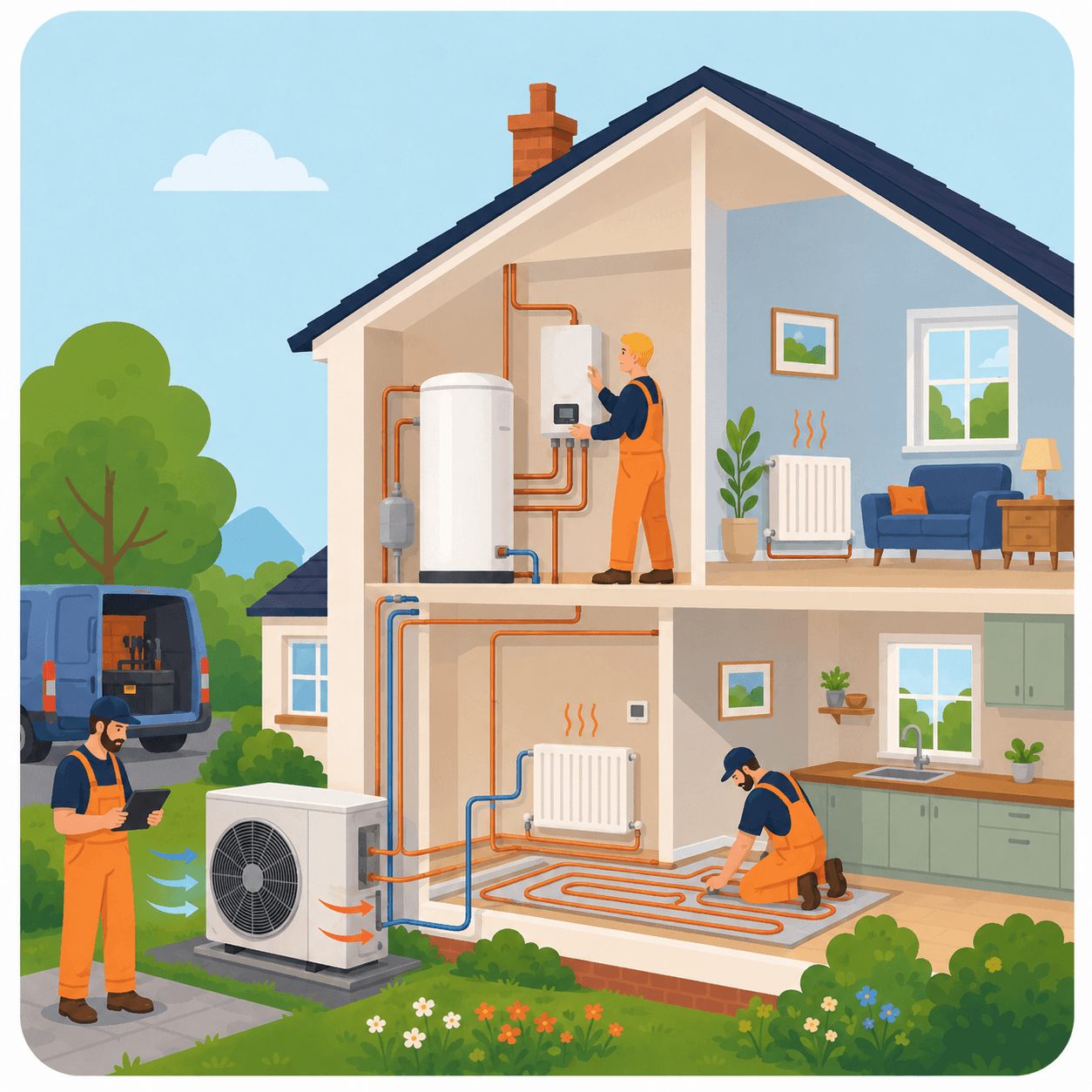
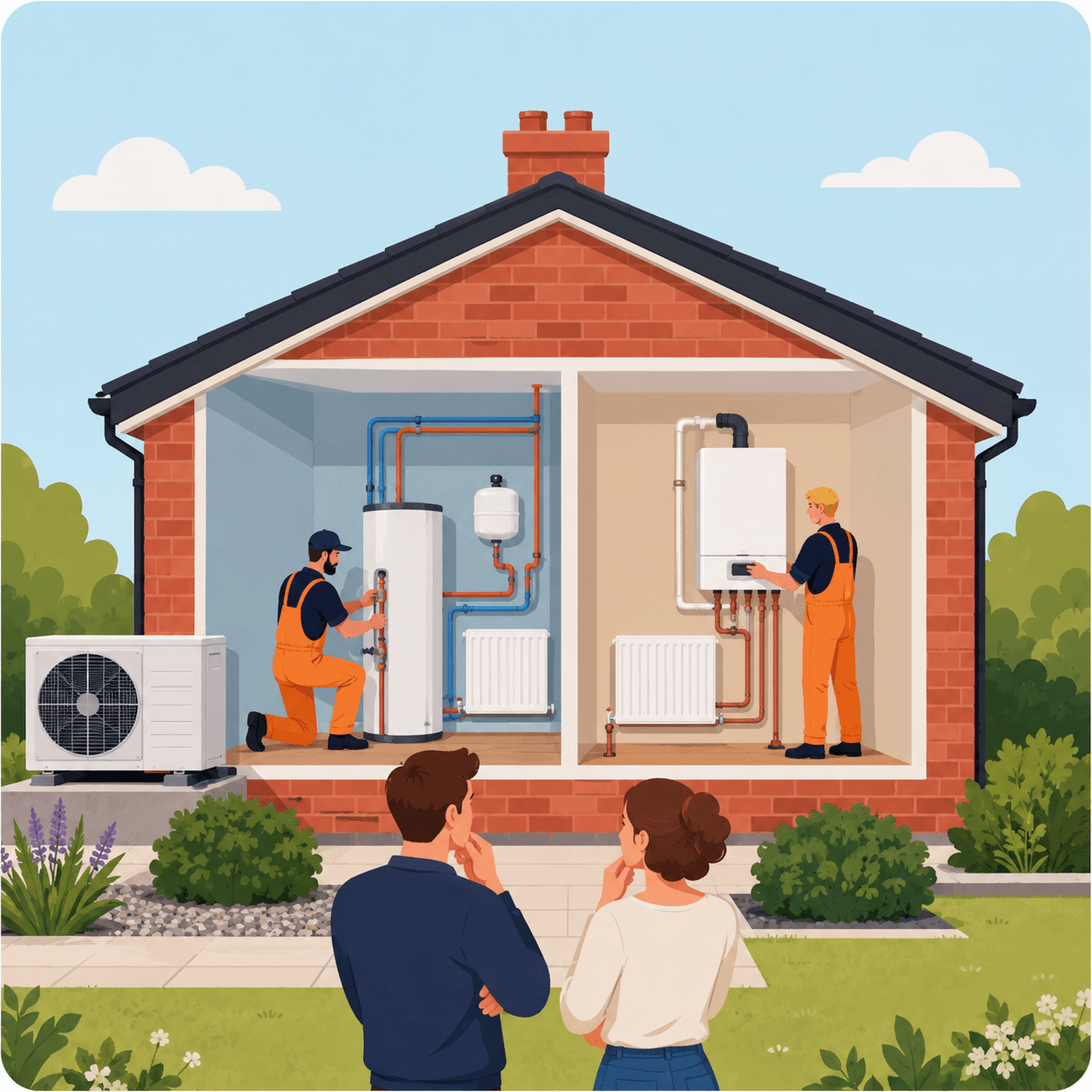
If your heating system is old, unreliable or becoming expensive to run, you may be wondering whether to replace it with a new boiler or consider a heat pump.
Both options can heat your home, but they work in very different ways. A new boiler may feel familiar and straightforward, especially if your home already has gas central heating. A heat pump, on the other hand, is a low-carbon heating system that can be highly efficient when installed in the right property.
There is no single answer that suits every home. The best choice depends on your property, your current heating setup, your budget, insulation levels, available space and long-term plans.
This guide explains the main differences in a clear, practical way.
What Is a Heat Pump?
A heat pump is a heating system that uses electricity to move heat from outside into your home. The most common type for UK homes is an air source heat pump, which takes heat from the outside air and uses it to warm your home and hot water.
Even when it feels cold outside, there is still heat energy in the air. A heat pump captures that heat and raises it to a useful temperature for your heating system.
Government guidance states that heat pumps can be around three times more energy efficient than traditional boilers, because they move heat rather than generating it by burning fuel. The Boiler Upgrade Scheme currently offers support in England and Wales to help with the cost of installing heat pumps, with grants of up to £7,500 available for eligible properties.
What Is a New Boiler?
A new boiler is a replacement heating appliance, usually fitted as part of an existing central heating system. In many UK homes, this means replacing an older gas boiler with a modern condensing boiler.
Energy Saving Trust explains that heating and hot water account for over half of what many households spend on energy bills, so the efficiency of your boiler can make a real difference. Modern condensing boilers are more efficient than older boilers because they recover more heat that would otherwise be lost through the flue.
For homes that already have a gas central heating system, replacing an old boiler can often be a relatively familiar upgrade. It may involve less disruption than changing to a completely different heating system.
The Main Difference Between a Heat Pump and a Boiler
The simplest difference is how they create heat.
A boiler burns fuel, usually gas, to generate heat. That heat is then sent around the home through radiators or underfloor heating.
A heat pump uses electricity to move heat from outside into the home. It does not burn gas in the property, which means it can reduce the carbon emissions linked to home heating.
A boiler usually produces hotter water for radiators, while a heat pump often works at lower flow temperatures over longer periods. This means a heat pump system needs to be carefully designed so the home stays warm without needing very high water temperatures.
When a Heat Pump May Be the Better Option
A heat pump may be worth considering if you want to move away from fossil fuel heating and are planning for the long term.
It may be a good fit if:
- Your home is reasonably well insulated
- Your radiators are suitable, or you are open to upgrading them
- You have space for an outdoor unit
- You want a lower-carbon heating system
- You are planning wider home energy improvements
- You may be eligible for heat pump funding
- You are comfortable with a heating system that runs differently from a boiler
Heat pumps tend to work best in homes that can hold onto heat. If a property is draughty or poorly insulated, the heat pump may have to work harder to keep it comfortable.
That does not mean older homes cannot have heat pumps. Many can. But the design needs to be right, and insulation, radiators and controls all need to be considered.
When a New Boiler May Be the Better Option
A new boiler may be the more practical choice if your current boiler is failing and you need a straightforward replacement.
It may be suitable if:
- Your home already has gas central heating
- You need a lower upfront cost
- Your radiators and pipework are already set up for a boiler
- Your current boiler is old, inefficient or unreliable
- You are not ready for wider heating system changes
- Your property is not yet suitable for a heat pump
- You need a quicker installation
A modern boiler can be a sensible improvement compared with an old, unreliable one. However, it is still worth thinking about insulation and heating controls at the same time, because these can affect comfort and running costs.
Think About Insulation First
Before choosing between a heat pump and a new boiler, it is worth looking at how well your home holds heat.
If heat is escaping through the roof, walls, floors, windows and draughts, any heating system will have to work harder. That applies whether you choose a boiler or a heat pump.
Useful improvements may include:
- Loft insulation
- Cavity wall insulation
- Solid wall insulation
- Underfloor insulation
- Draught-proofing
- Better heating controls
- Improved windows or glazing where needed
This is especially important in older homes across the North West, where property types can vary from Victorian terraces and rural cottages to post-war semis and more modern homes.
A well-insulated home is usually easier and cheaper to heat, whatever system you choose.
Running Costs: Which Is Cheaper?
This is one of the most common questions, but the answer is not always straightforward.
A heat pump is usually much more efficient than a boiler, but it uses electricity, which has historically been more expensive per unit than gas. This means running costs depend on the heat pump’s efficiency, electricity tariff, property insulation, heating habits and system design.
A new boiler may have a lower upfront cost and can be cheaper to install, especially if replacing an existing gas boiler. However, it will still depend on gas prices and the efficiency of the wider heating system.
Rather than looking only at the appliance, it is better to consider the whole home:
- How much heat does the property lose?
- Are the radiators correctly sized?
- Are the controls easy to use?
- Is the heating system regularly maintained?
- Could solar panels or smart tariffs support electricity use?
- Are grants or funding available?
The cheapest option upfront is not always the best long-term option, but the lowest-carbon option may not be the easiest immediate choice for every household.
Installation Disruption
A boiler replacement is often more straightforward if the new boiler is going in the same location and the existing pipework, radiators and controls are suitable.
A heat pump installation can involve more planning. It may require:
- An outdoor unit
- A hot water cylinder
- Radiator upgrades
- Pipework changes
- Electrical work
- New controls
- A more detailed heat loss calculation
This does not mean a heat pump installation has to be difficult, but it is usually more involved than a like-for-like boiler replacement.
A good installer should explain what work is needed before anything is agreed.
What About Hot Water?
Both boilers and heat pumps can provide hot water, but they often do it differently.
A combi boiler heats water on demand, so many homes do not need a separate hot water cylinder.
Heat pumps usually work with a hot water cylinder, which stores hot water for use when needed. This means space for a cylinder may be an important consideration.
If your home previously had a hot water cylinder, this may be easier to plan. If you currently have a combi boiler and no cylinder, switching to a heat pump may require finding suitable space.
What About Radiators?
Radiators are another key difference.
Boilers can heat water to higher temperatures, so existing radiators may still work even if they are not especially large.
Heat pumps usually work more efficiently at lower flow temperatures. This means some homes may need larger radiators, improved pipework or underfloor heating to deliver enough warmth.
This is why a proper room-by-room heat loss calculation matters. It helps work out whether the existing radiators are suitable or whether changes are needed.
Which Option Is Better for Older Homes?
Older homes need careful assessment.
A new boiler may be a practical short-term option if the home already has central heating and needs a reliable replacement.
A heat pump may also be suitable, but the property may need insulation improvements, radiator upgrades or ventilation checks first.
For older properties, the question is not simply “heat pump or boiler?” It is more useful to ask:
- How much heat does the home lose?
- Is the loft properly insulated?
- Are the walls cavity or solid walls?
- Are there draughts or cold floors?
- Are the radiators large enough?
- Is there space for a cylinder?
- Is the electrical supply suitable?
- Are there damp or ventilation issues?
Once those questions are answered, the right heating option becomes much clearer.
Questions to Ask Before Deciding
Before choosing a heat pump or new boiler, ask:
- What is wrong with my current heating system?
- Is my home well insulated?
- What is my current EPC rating?
- Do I want the lowest upfront cost or a longer-term low-carbon option?
- Is there space for a heat pump outdoor unit and hot water cylinder?
- Would my radiators need upgrading?
- Could I qualify for funding?
- How much disruption can I manage?
- How long do I plan to stay in the property?
- Has a proper home assessment been carried out?
These questions can help you avoid choosing a system based only on price or popularity.
So, Which Is Right for Your Home?
A new boiler may be right if you need a familiar, lower-disruption replacement for an existing heating system and your property is not yet ready for a heat pump.
A heat pump may be right if you want a lower-carbon heating system, your home is suitable or can be made suitable, and you are comfortable planning the installation properly.
For many households, the best approach is to look at the whole property first. Insulation, heating controls, radiators, hot water and ventilation all affect how well any heating system performs.
Final Thoughts
Choosing between a heat pump and a new boiler is not always a quick decision. Both options can make sense in the right circumstances.
A new boiler can be a practical upgrade where an existing system is failing. A heat pump can be a strong long-term option for households looking to reduce carbon emissions and move towards more efficient electric heating.
The most important step is getting clear, property-specific advice. A proper assessment can help you understand what your home needs, what funding may be available, and which option is likely to work best for your circumstances.
At Warmr, we help homeowners understand their options for energy-efficient home upgrades, including heating improvements, insulation and low-carbon technologies. The right solution starts with your home, not a one-size-fits-all recommendation.