Heating your home efficiently is not just about having a good boiler or a well-insulated property. It is also about having the right level of control.
Many households use more energy than they need because their heating is on for too long, set too high, or warming rooms that are not being used. Smart heating controls can help reduce this waste by making it easier to manage when, where and how your home is heated.
They are not a magic fix for every property, but when used properly, smart heating controls can be a simple and practical way to improve comfort, reduce wasted energy and make your heating system easier to manage.
What Are Smart Heating Controls?
Smart heating controls are devices that help you manage your heating more precisely. They often replace or upgrade older thermostats, timers or programmers.
Depending on the system, smart heating controls may allow you to:
- Set heating schedules
- Control your heating from an app
- Adjust temperatures room by room
- Turn the heating off remotely
- Monitor your heating usage
- Learn your routine over time
- Avoid heating an empty home
- Manage your heating around the weather or occupancy
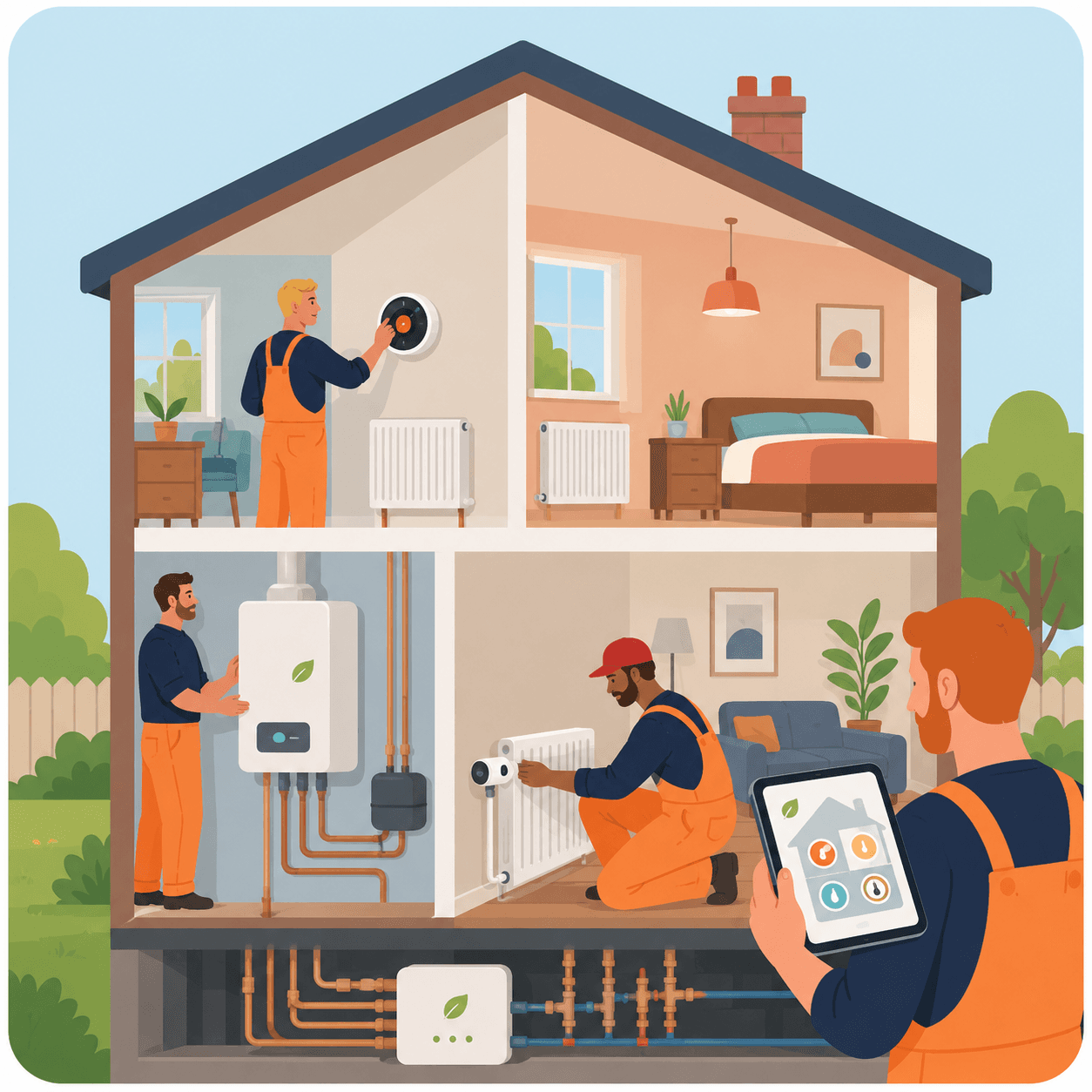
Some systems are fairly simple, such as a smart thermostat connected to your boiler. Others are more advanced and include smart radiator valves, room-by-room zoning and app-based energy insights.
The aim is not to make heating complicated. The aim is to give you more control, so your home is warm when it needs to be and not using energy when it does not.
Why Heating Controls Matter
Heating and hot water are a major part of home energy use. Energy Saving Trust says that, in a typical household, over half of fuel bills are spent on heating and hot water. It also explains that an efficient heating system that is easy to control can help reduce fuel bills and lower carbon emissions.
This is why controls matter. Even a good heating system can waste energy if it is running at the wrong times or heating spaces unnecessarily.
For example, energy waste can happen when:
- The heating comes on before anyone is home
- The whole house is heated when only one room is being used
- The thermostat is set higher than needed
- Heating is left on overnight by mistake
- Radiators are heating unused rooms
- The system has an old timer that does not match your routine
- People manually override the heating and forget to turn it back down
Smart heating controls are designed to make these situations easier to avoid.
How Smart Heating Controls Reduce Energy Waste
The biggest benefit of smart heating controls is that they help match your heating to your lifestyle.
A traditional timer might turn the heating on at the same time every day. That can work well for some households, but it may waste energy if your routine changes. Smart controls can make it easier to adjust schedules, turn heating off when plans change, or reduce temperatures when nobody is home.
Energy Saving Trust explains that heating controls help keep a home comfortably warm without overheating rooms and wasting energy. It also says that installing and using heating controls effectively could help households use less energy and save money.
This does not mean every household will save the same amount. Savings depend on your current heating habits, property type, insulation, heating system and how well the controls are used.
Common Types of Heating Controls
Smart heating is not one single product. It usually refers to a combination of controls that work together.
Smart Thermostats
A smart thermostat lets you control the overall temperature of your home. Many models connect to Wi-Fi and can be adjusted using a phone app.
This can be useful if you forget to turn the heating off, come home earlier than expected, or want to adjust the temperature without using the wall control.
A room thermostat works by switching the heating on until the room reaches the chosen temperature, then switching it off until the room cools slightly. Energy Saving Trust recommends setting the thermostat to the lowest comfortable temperature, which for most people is between 18°C and 21°C.
Programmers and Timers
Programmers allow you to choose when your heating and hot water come on and off. Older systems may only offer basic settings, while modern smart controls can provide more flexible scheduling.
This is useful because most homes do not need heating at full temperature all day. A good schedule can help the home feel comfortable without running the heating longer than necessary.
Thermostatic Radiator Valves
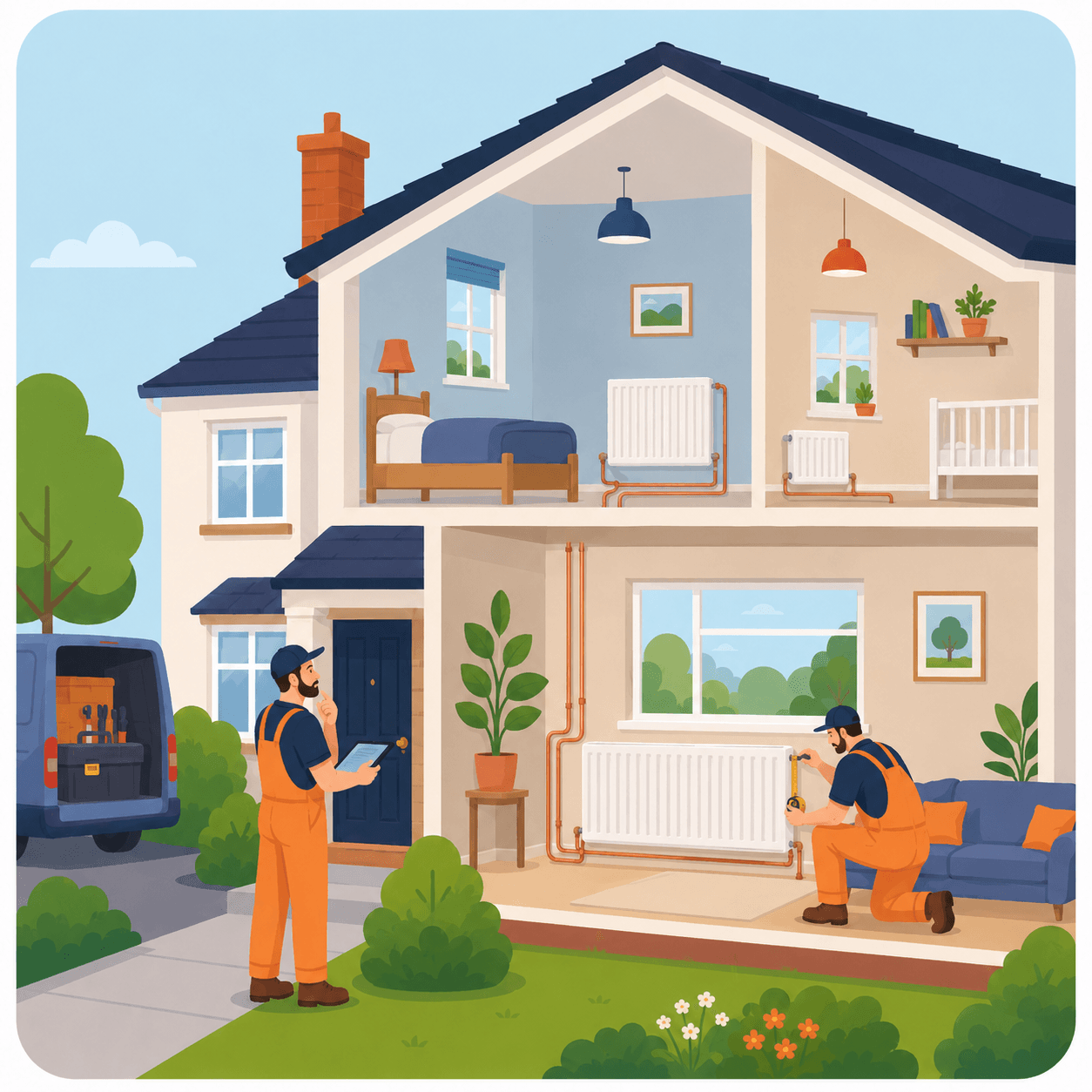
Thermostatic radiator valves, often called TRVs, allow you to control individual radiators. This helps avoid overheating rooms that do not need as much warmth.
For example, you might want a living room warmer in the evening, but a spare bedroom kept cooler most of the time. TRVs can help manage this more efficiently.
Smart Radiator Valves
Smart radiator valves take this a step further by allowing room-by-room control through an app or smart system. They can be useful in larger homes, homes with irregular routines, or properties where some rooms are used much more than others.
Zoned Heating Controls
Zoned heating allows different parts of the property to be heated separately. This can be useful in larger homes, extensions, home offices, or properties where upstairs and downstairs are used at different times.
Instead of heating the whole home as one space, zoning gives more control over where warmth is needed.
Are Smart Heating Controls the Same as a Smart Meter?
No. A smart meter and smart heating controls are different things.
A smart meter records your energy use and sends readings to your supplier. It can help you see how much energy you are using, often through an in-home display.
Smart heating controls manage your heating system. They help control temperature, schedules and room-by-room heating.
They can work well together, but they do different jobs. A smart meter shows energy use. Smart heating controls help you manage heating use.
Do Smart Heating Controls Save Money?
They can, but the amount varies.
Energy Saving Trust says installing a programmer, room thermostat and thermostatic radiator valves could save around £110 a year in Great Britain when used effectively.
However, smart controls only save energy when they are set up and used properly. If a household installs a smart thermostat but leaves the heating on all day at a high temperature, the benefit may be small.
It is also worth being realistic. Smart controls are a useful upgrade, but they are not a substitute for good insulation, a well-maintained heating system or sensible heating habits.
Research has also raised a useful caution: smart thermostats do not automatically guarantee savings if people find them confusing or do not use them efficiently. One study noted that while smart heating controls are often expected to save energy, there is limited evidence that they are always more usable than traditional thermostats or that they always lead to more efficient heating behaviour.
The key point is simple: smart heating controls work best when they make heating easier to manage, not harder.
Simple Ways to Use Heating Controls More Efficiently
Smart controls are most useful when paired with sensible settings.
Set a Comfortable, Not Excessive, Temperature
Energy Saving Trust says most people are comfortable between 18°C and 21°C, and that turning a thermostat down by one degree, from 22°C to 21°C, could save around £90 a year in Great Britain.
That does not mean everyone should set their heating the same way. Older people, young children and people with health conditions may need warmer temperatures. The aim is to avoid overheating, not to make the home uncomfortable.
Build a Schedule Around Your Routine
Instead of leaving the heating on constantly, set it around when people are usually home and awake.
For example, you might set the heating to come on before the morning routine, reduce during the day, come back on in the evening, and lower again overnight.
Use Room-by-Room Control
Rooms do not all need to be the same temperature. Bedrooms, spare rooms, hallways and rarely used spaces may not need as much heat as the living room or home office.
TRVs or smart radiator valves can help you avoid heating every room equally.
Avoid Turning the Thermostat Up Too High
A common mistake is turning the thermostat up high to make the house warm faster. For most central heating systems, this does not heat the home more quickly. It usually just means the heating runs for longer and may overshoot the comfortable temperature.
Use App Control Sensibly
App control is useful when plans change. If you are delayed getting home, you can keep the heating off for longer. If you are returning early, you can turn it on before you arrive.
This can help avoid heating an empty property.
When Smart Heating Controls Are Most Useful
Smart heating controls can be helpful in many homes, but they are especially useful where routines vary.
They may be worth considering if:
- Your current thermostat or timer is old or difficult to use
- Your heating comes on when nobody is home
- Some rooms are often too hot or too cold
- You work from home some days but not others
- You have a larger property
- You want better room-by-room control
- You often forget to turn heating down or off
- You want to monitor heating habits more closely
- You are upgrading your boiler or central heating system
They can also be useful in older homes across the North West, where property layouts can vary widely. A terraced house, bungalow, semi-detached home and rural property may all need different heating patterns.
When Smart Controls May Not Be the First Priority
Smart controls are useful, but they may not be the most urgent upgrade in every home.
Other improvements may be more important if:
- Your boiler is very old or unreliable
- Your home has little or no loft insulation
- Rooms lose heat very quickly
- Windows or doors are very draughty
- Radiators do not heat properly
- Your heating system is poorly maintained
- The property has damp or ventilation issues
In these cases, smart controls may still help, but the bigger issue could be heat loss or heating system performance.
A sensible approach is to look at the whole home. Controls help you manage heating more efficiently, but insulation helps keep the heat in.
Smart Controls and Boiler Upgrades
If you are replacing an old boiler, it is a good time to think about heating controls too.
A modern boiler with poor controls may not perform as well as it could. Better controls can help the system operate more efficiently and make it easier to manage.
Energy Saving Trust explains that heating systems can include programmers, thermostats and radiator valves to help heat the home only when needed.
When upgrading a boiler, it is worth asking whether the new system will include:
- A room thermostat
- A programmer or smart thermostat
- Thermostatic radiator valves
- Weather compensation, where suitable
- Load compensation, where suitable
- Zoned controls for larger homes
- Clear instructions on how to use everything
The controls should suit the household, not just the heating system.
Smart Controls and Heat Pumps
Smart controls can also be used with heat pumps, but heat pumps are often controlled differently from traditional boilers.
Heat pumps usually work best when they run steadily at lower temperatures rather than switching on and off sharply. For that reason, the right control strategy is important.
If you have, or are considering, a heat pump, it is best to use controls designed for that system and follow installer guidance.
Nesta’s HeatFlex project found that automated energy-saving measures could reduce household consumption while maintaining comfortable home temperatures in heat pump homes, showing the potential value of smarter control for low-carbon heating systems.
Will Smart Heating Controls Improve Your EPC Rating?
They may help, but it depends on the property and the existing controls.
An EPC looks at several parts of the home, including heating, insulation, hot water, lighting and overall energy performance. Better heating controls can be one of the improvements recommended, particularly where existing controls are basic or missing.
However, controls alone may not dramatically change a poor EPC rating. Larger improvements, such as insulation, heating system upgrades or solar panels, may have a bigger impact depending on the property.
Smart controls are best seen as one useful part of a wider energy efficiency plan.
What Should You Check Before Installing Smart Heating Controls?
Before choosing a smart heating control system, it is worth checking:
- Is it compatible with your boiler or heating system?
- Does it work with your radiators and existing controls?
- Do you want whole-home control or room-by-room control?
- Is the app easy for everyone in the household to use?
- Does it need Wi-Fi to function fully?
- What happens if the internet goes down?
- Are there subscription costs?
- Can it be expanded later?
- Will it be installed professionally?
- Will you be shown how to use it?
The best system is not always the most advanced one. It is the one your household will actually use.
Common Mistakes to Avoid
Smart heating controls are designed to simplify heating, but there are a few common mistakes that can reduce their usefulness.
Avoid:
- Setting the thermostat higher than needed
- Heating unused rooms all day
- Ignoring radiator valve settings
- Creating schedules that no longer match your routine
- Turning off heating completely in a way that causes damp or comfort issues
- Installing controls without understanding how to use them
- Assuming smart controls will fix poor insulation
- Choosing a system that is too complicated for the household
A simple setup used well is often better than an advanced system nobody understands.
Final Thoughts
Smart heating controls can be a simple and effective way to reduce energy waste. They help you manage when your heating comes on, how warm your home gets, and which rooms are heated.
They are most useful when they make heating easier to control and when they are used alongside sensible settings. They can support lower energy use, better comfort and improved day-to-day control, especially in homes where routines change or some rooms are used more than others.
However, smart controls are not a complete solution on their own. For the best results, they should be considered alongside insulation, boiler performance, radiator efficiency and the overall condition of the property.
At Warmr, we help homeowners understand practical ways to make their homes warmer, more efficient and easier to manage. Smart heating controls can be a useful part of that picture, especially when chosen carefully and set up around how the household actually lives.