Air source heat pumps are usually easy to spot once you know what you are looking for. The outdoor unit often looks a little like an air conditioning unit, with a fan inside a rectangular casing.
But where does it actually go?
The short answer is: an air source heat pump outdoor unit goes outside your home, in a position with good airflow, safe access and a sensible route back into the heating system inside the property.
The best location depends on the home. A terraced house, semi-detached home, bungalow, cottage or detached property may all need a different setup. The aim is to place the unit somewhere it can work efficiently, be serviced safely, and cause as little disruption as possible.
This guide explains where an air source heat pump can go, what installers look for, and what homeowners should know before choosing a location.
What Part of the Heat Pump Goes Outside?
An air source heat pump system has an outdoor unit. This is the part that sits outside the property and draws heat from the air.
The outdoor unit contains key components such as a fan and heat exchanger. It pulls in outside air, extracts heat from it and transfers that heat into the system. The heat is then used inside the home for space heating and, in many systems, hot water.
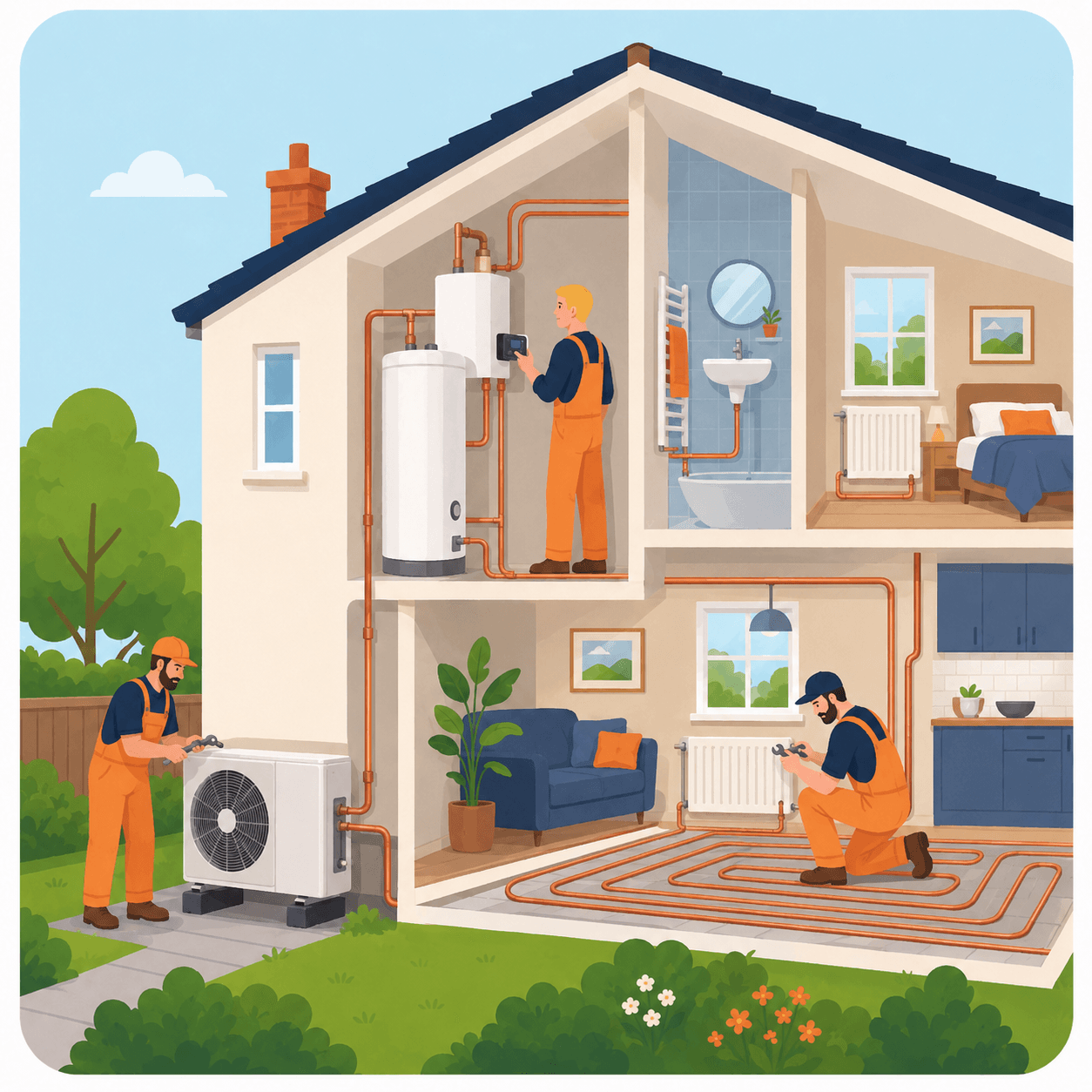
The outdoor unit is usually connected to indoor equipment, which may include:
- A hot water cylinder
- Heating controls
- Pipework
- Radiators or underfloor heating
- An indoor hydraulic unit or control unit, depending on the system
- Electrical connections
So, while the visible fan unit goes outside, the full system includes both outdoor and indoor parts.
Common Places to Install an Air Source Heat Pump
The right location depends on the layout of the property, but common locations include:
- At the side of the house
- In the rear garden
- On a patio area
- On a flat outdoor base near an external wall
- On a suitable external wall bracket
- Near a utility room, kitchen or plant area
- In a side return, where there is enough space and airflow
- On a suitable flat roof, where allowed and practical
Most units are ground-mounted on a firm base. Wall-mounted units are also possible in some situations, but the structure needs to be suitable and the unit must still have enough airflow and access.
The outdoor unit should not be hidden away in a tight, enclosed space. It needs to breathe.
Why Airflow Matters
Airflow is one of the most important things to get right.
An air source heat pump works by moving air across the outdoor unit. If the unit is boxed in, crowded by plants, pushed into a tight corner or placed too close to walls and fences, airflow can be restricted.
Poor airflow can make the system work harder, which may reduce efficiency and performance.
A good location should have:
- Clear space around the unit
- No tight enclosure
- No blocked fan area
- Room for air to enter and leave the unit
- Space away from dense shrubs or overgrown plants
- Easy access for cleaning and servicing
This does not mean the unit needs to dominate the garden. It simply needs enough open space to work properly.
Should the Unit Be Near the House?
In many cases, yes.
The outdoor unit is often placed close to the property because it needs to connect back into the home’s heating system. Shorter pipe runs can make installation simpler and may help reduce heat loss from external pipework.
However, “close to the house” does not mean it can go anywhere. The installer still needs to think about:
- Airflow
- Noise
- Access
- Pipe routes
- Drainage
- Appearance
- Neighbouring properties
- Planning rules
- Future maintenance
A unit beside an external wall can work well if there is enough clearance and the position is practical.
Can an Air Source Heat Pump Go in the Front Garden?
Sometimes, but it needs careful thought.
A front garden may be possible where it is the most practical location, but there may be planning, appearance and noise considerations. In some areas, especially conservation areas or properties facing a highway, there can be extra restrictions.
Many homeowners prefer a side or rear location because it is less visually prominent and may be easier to position away from windows and neighbours.
Before installing at the front of a home, it is worth checking:
- Is the property in a conservation area?
- Does the unit face a road or public highway?
- Will it affect the appearance of the home?
- Is there enough airflow?
- Will it be close to windows or neighbouring homes?
- Is planning permission needed?
A front location may be suitable for some homes, but it should not be assumed.
Can a Heat Pump Go Down the Side of a House?
A side passage or side return can sometimes be a good location, particularly for semi-detached or detached homes.
However, side passages can also be narrow. If the unit is squeezed into a tight space, airflow may be poor and sound may reflect between walls.
Before choosing a side location, an installer should check:
- Width of the passage
- Airflow clearance around the unit
- Distance from windows and doors
- Distance from neighbouring walls
- Access for servicing
- Drainage
- Whether the passage is used regularly
- Whether the unit could be damaged by bins, bikes or storage
If the side path is wide and open enough, it may be a practical option. If it is narrow and enclosed, another location may be better.
Can an Air Source Heat Pump Go in a Back Garden?
Yes, a rear garden is often one of the most practical locations.
A back garden may provide more space, better airflow and less visual impact from the street. It can also make it easier to position the unit away from bedrooms, living room windows and neighbouring properties.
A good rear garden location might be:
- Against an external wall with suitable clearance
- On a firm base near the property
- Away from seating areas where noise may be more noticeable
- Clear of plants, leaves and garden storage
- Accessible for servicing
- Close enough for sensible pipe routes
The unit should be easy to reach. If it is placed too far down the garden, installation may become more complex and pipe runs may be less efficient.
Can a Heat Pump Be Wall-Mounted?
Some air source heat pump units can be wall-mounted using suitable brackets.
Wall mounting may be considered where ground space is limited or where the unit needs to sit above ground level. However, it is not suitable for every home.
The wall must be strong enough, and vibration control needs to be considered. The installer will also need safe access for fitting and future servicing.
Wall mounting may not be ideal if:
- The wall is weak or unsuitable
- The unit would be close to a bedroom window
- Access for maintenance would be difficult
- Vibration could transfer into the building
- The position restricts airflow
- Planning rules do not allow it
Ground mounting is often simpler, but wall mounting can work in the right situation.
Can a Heat Pump Go on a Flat Roof?
In some cases, a heat pump can be installed on a flat roof, but it needs careful assessment.
A roof installation may be considered where there is limited ground space, such as in some urban properties, flats or homes with small gardens.
However, roof installations need extra thought around:
- Structural strength
- Safe access
- Maintenance
- Vibration
- Noise
- Drainage
- Planning requirements
- Distance from roof edges
- Visual impact
- Pipework routes
Flat roof installations are more complex than simple ground-mounted installations. They should be carefully designed rather than treated as a default option.
Can a Heat Pump Go in a Garage or Shed?
Usually, the outdoor unit should not be installed inside a standard garage or shed.
An air source heat pump needs a large volume of moving outdoor air. If it is placed inside an enclosed space, it may quickly cool that space down and struggle to extract enough heat. It may also recirculate cold air, reducing performance.
A shed, garage or cupboard is normally not suitable unless it has been specifically designed to provide the required airflow, access and ventilation. For most homes, the outdoor unit should be genuinely outside.
Indoor equipment, such as a cylinder or control unit, may be located inside the property, but the fan unit needs open air.
How Much Space Does an Air Source Heat Pump Need?
The space needed depends on the size and model of the unit.
As a broad guide, the outdoor unit needs enough room for:
- The unit itself
- Airflow around the sides and front
- Service access
- Pipework and electrical connections
- Safe working space for installers
- Drainage around the base
The manufacturer will set specific clearance requirements. These should be followed carefully.
It is not enough to check whether the unit physically fits. It also needs space to operate properly.
Why Noise Needs to Be Considered
Air source heat pumps are not usually loud, but they do make some noise because the outdoor unit contains a fan and compressor.
The level of noise depends on:
- The model
- How hard the unit is working
- Outdoor temperature
- Installation quality
- Mounting method
- Nearby walls and fences
- Distance from windows
- Distance from neighbours
- Acoustic surroundings
A good location should consider both your own home and nearby properties. Placing the unit directly below a bedroom window, beside a neighbour’s window or in a narrow echoing passage may not be ideal.
The aim is not just to meet technical requirements, but to choose a location that is practical and considerate.
What About Neighbours?
Neighbouring properties should be considered when choosing the location.
Even a quiet heat pump can be more noticeable if it is placed close to a neighbour’s window, boundary or outdoor seating area. Sound can also reflect off hard surfaces such as walls, fences and narrow passageways.
Before installation, it is worth thinking about:
- Where neighbouring windows are located
- Whether the unit faces a boundary
- Whether nearby walls may reflect sound
- Whether the unit will run near bedrooms
- Whether there is a better location with more open space
- Whether screening can be used without blocking airflow
A well-planned location can help avoid future issues.
Does the Unit Need a Concrete Base?
Many outdoor units are installed on a firm, level base.
This might be a concrete base, paving slabs or another suitable support system specified by the installer. The base needs to keep the unit stable, level and raised appropriately from the ground.
The base should help:
- Support the weight of the unit
- Keep it level
- Reduce vibration
- Prevent sinking or movement
- Keep the unit clear of mud or standing water
- Allow drainage around the unit
A poor base can lead to vibration, noise, movement or drainage problems, so it should not be overlooked.
Drainage and Defrost Water
Air source heat pumps can produce water during operation, especially during defrost cycles in cold weather.
This water needs somewhere safe to drain away. If drainage is poor, water may collect around the base of the unit, create slippery surfaces or cause problems in freezing conditions.
A suitable location should consider:
- Where defrost water will go
- Whether water could pool near paths
- Whether drainage is needed
- Whether the unit is near a doorway or walkway
- Whether cold weather could create ice patches
- Whether the base remains stable and dry
This is a small detail, but an important one for everyday use.
Where Do the Indoor Components Go?
The outdoor unit is only one part of the system. Air source heat pumps also need space indoors.
Depending on the system, indoor components may include:
- Hot water cylinder
- Buffer tank, in some designs
- Hydraulic unit
- Expansion vessel
- Controls
- Pumps and valves
- Pipework connections
A hot water cylinder is often placed in an airing cupboard, utility room, loft space, garage or plant cupboard, depending on the property.
If you currently have a combi boiler and no cylinder, the installer will need to find suitable indoor space. This can be one of the biggest practical considerations when planning a heat pump installation.
Where Does the Hot Water Cylinder Go?
For many air-to-water heat pump systems, a hot water cylinder is needed.
Common cylinder locations include:
- Airing cupboard
- Utility room
- Garage
- Loft space, if suitable
- Plant room
- Large cupboard
- Former boiler cupboard
The cylinder location should consider:
- Space
- Floor strength
- Pipework routes
- Access for maintenance
- Distance to bathrooms and kitchens
- Heat loss from pipework
- Safety controls
- Future servicing
If the home already has a cylinder, the existing location may be usable, although the cylinder may need upgrading to one designed for a heat pump.
What About Pipe Routes?
Pipe routes matter because the outdoor unit needs to connect to the indoor heating system.
Installers will look for sensible routes for pipework between:
- Outdoor unit
- Indoor unit or cylinder
- Radiators
- Underfloor heating circuits
- Existing heating pipework
- Controls and electrical supply
Short, well-insulated pipe runs are usually preferred. Long or awkward routes may increase installation complexity and can affect performance if not designed properly.
The pipework should also be protected where needed, especially if it runs outside.
Does the Heat Pump Need to Be Close to the Consumer Unit?
An air source heat pump needs an electrical supply, so the installer will need to assess the electrical side of the property.
This does not necessarily mean the outdoor unit has to be next to the consumer unit, but the electrical connection needs to be safe, suitable and compliant.
The installer or electrician may check:
- Existing electrical capacity
- Consumer unit condition
- Cable routes
- Isolation switches
- Earthing and bonding
- Outdoor electrical protection
- Whether upgrades are needed
Electrical planning is part of choosing a suitable location.
Planning Permission and Permitted Development
Many air source heat pump installations can fall under permitted development, meaning a planning application may not be needed if all conditions are met.
However, rules depend on the property, location and installation details.
Planning considerations may include:
- Size of the outdoor unit
- Number of units
- Whether the property is listed
- Whether the property is in a conservation area
- Whether the unit is on a wall facing a highway
- Whether the unit is on a roof
- Noise standards
- Visual impact
- Local restrictions or planning conditions
It is always worth checking before work begins, especially for listed buildings, conservation areas, flats and unusual properties.
What If You Live in a Terrace?
Terraced homes can still have air source heat pumps, but siting may need more thought.
A terraced property may have less side access, smaller gardens and closer neighbours. The outdoor unit may need to go in a rear yard, small garden or another suitable external space.
Challenges can include:
- Limited outdoor space
- Narrow access
- Nearby windows
- Boundary proximity
- Small yards
- Pipe routes through the home
- Space for a cylinder
- Visual appearance
None of these automatically rule out a heat pump, but the assessment needs to be property-specific.
What If You Live in a Flat?
Flats can be more complicated.
An individual air source heat pump may be difficult if there is no private outdoor space, no suitable wall, limited access, leasehold restrictions or shared building ownership.
Possible issues include:
- Freeholder permission
- Building management consent
- Planning rules
- Noise impact
- Space for outdoor units
- Pipe routes through communal areas
- Maintenance access
- Visual appearance
- Whether a whole-building solution is more suitable
Some flats may be suitable, but the process usually needs more coordination than a standard house installation.
Can the Unit Be Hidden?
Many homeowners want the outdoor unit to be discreet. That is understandable, especially where garden space is limited.
However, the unit should not be boxed in or hidden in a way that blocks airflow. Solid covers, tight screens or enclosed cupboards can reduce performance and make servicing difficult.
If you want to screen the unit, consider:
- Leaving enough clearance for airflow
- Keeping access for servicing
- Avoiding solid barriers directly in front of the fan
- Using planting carefully, without overgrowth
- Following manufacturer guidance
- Making sure screens do not reflect noise towards neighbours
A unit can often be made less visually prominent, but performance should come first.
Can Plants Grow Around a Heat Pump?
Plants can help soften the appearance of the outdoor unit, but they need to be managed carefully.
Avoid planting too close to the unit. Leaves, grass cuttings and shrubs can block airflow or collect around the fan.
If planting nearby, allow enough space for:
- Air movement
- Service access
- Growth over time
- Leaf fall and debris control
- Safe drainage
Low-maintenance planting set back from the unit can work well. Dense shrubs directly against the unit are usually a bad idea.
Maintenance Access Matters
The outdoor unit will need servicing and occasional checks.
That means the installer should be able to reach it safely after installation. A location that is convenient on day one may become frustrating if it is behind locked gates, dense planting, narrow access or awkward steps.
Good maintenance access should allow:
- Safe approach to the unit
- Space to remove covers or panels
- Access to electrical isolation
- Access to pipe connections
- Space for cleaning around the unit
- Safe working conditions in winter
A hidden or cramped location can make future servicing more difficult.
Where Shouldn’t an Air Source Heat Pump Go?
An air source heat pump outdoor unit is usually best avoided in locations where it would be:
- Boxed into a tight enclosure
- Too close to windows
- Difficult to access
- Surrounded by dense planting
- Placed on an unstable base
- Likely to collect standing water
- In a narrow echoing passage, if avoidable
- Blocking a walkway or doorway
- Vulnerable to accidental damage
- Too close to neighbours without proper noise consideration
- Installed without planning checks where needed
The best location is usually a balance of performance, practicality and appearance.
What Will the Installer Check During a Survey?
During a heat pump survey, the installer should look at both the outdoor and indoor requirements.
For the outdoor unit, they may check:
- Available space
- Airflow
- Noise impact
- Boundary and neighbour positions
- Ground conditions
- Mounting options
- Drainage
- Pipe routes
- Electrical supply route
- Service access
- Planning restrictions
For the indoor system, they may check:
- Hot water cylinder space
- Existing heating pipework
- Radiator sizes
- Controls
- Insulation levels
- Electrical supply
- Household hot water demand
- Heating layout
The final location should be chosen as part of the whole heating system design.
Questions to Ask Before Choosing a Location
Before agreeing to a heat pump location, ask:
- Why is this location being recommended?
- Is there enough airflow around the unit?
- Will the unit be easy to service?
- Where will pipework enter the house?
- Where will the hot water cylinder go?
- How will drainage be handled?
- Will the unit be close to any windows?
- Has noise been considered?
- Will neighbours be affected?
- Is planning permission needed?
- Can the unit be screened without blocking airflow?
- What happens if the garden layout changes later?
A good installer should be able to explain the reasoning clearly.
Final Thoughts
An air source heat pump usually goes outside the home, often on the ground near an external wall, at the side or rear of the property. It needs good airflow, safe access, suitable drainage and a practical pipe route into the home.
The exact position depends on the property. A good location is not just about where the unit fits. It also needs to consider noise, appearance, servicing, planning rules, indoor cylinder space and how the heating system connects together.
For the best results, the heat pump location should be planned as part of a full home assessment, not chosen as an afterthought.
At Warmr, we help homeowners understand practical energy-efficient home upgrades, including heat pumps, insulation, heating controls and wider home improvements. The right approach starts with looking carefully at the property, so the system is designed around how the home actually works.